

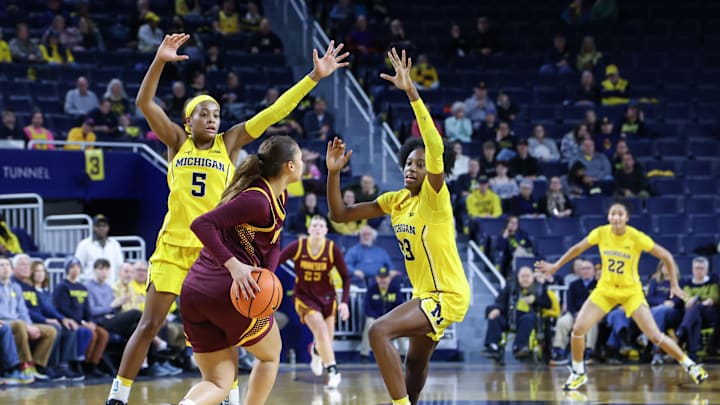
The visit to Eugene and Seattle exposed the offense of the Michigan women's basketball team. It looked like it would be more of the same against the visiting Minnesota Gophers on Monday night, whose lineup featured size and bulk on the inside and length on the perimeter. They also led the NCAA in opponents' points per game at 49.9. Wolverines coach Kim Barnes Arico and her staff had to adjust.
The adjustment was ball pressure. Barnes Arico and staff were surely aware that the Gophers were leading the nation in turnovers per game at 9.8, but they also knew the Wolverines had scrappy, quick, ball hawking players. It proved to be the key to the Wolverines victory. At the end of the first half, the Gophers had 10 turnovers and ended the game with 17. Even more importantly, the Wolverines converted them into points with 19.
Starts with taking away space
In the first minute and a half, the Gophers had three turnovers, two errant passes and a travel. This was induced by 5’ 7” sophomore Brook Quarles Daniels bodying 6’ 1” sophomore Tori McKinney and taking away her space. Good ball pressure isn’t just for the perimeter.
The fourth turnover was at 3:48 in the first period and is a great example of blitzing the pick and roll. First of all, the Gophers were in an offensive set that was susceptible to it, with the post player and two wings deep in the court while the ball handler and screen setter were above the 3-point line. All of their Wolverine defenders had their eyes on the ball in great hedge position to go after a pass.
The ballhandler does a poor job of initiating the pick and roll, leaving too much space between her and the screener, and sophomores Kendall Dudley and Olivia Olson trap her at the logo. Instead of passing to a covered teammate who was coming towards her or keeping her dribble alive and resetting the offense, the ballhandler tries a two handed over the head zip pass to the screener who has rolled to the basket uncovered. This allows Dudley to get a hand on the pass, deflecting it to sophomore Syla Swords.
Jump, jump, jump to it!
The Wolverines perfectly executed another type of ball pressure called “jump full court press.” When the Gophers inbound the ball after a made basket, the Wolverines employ immediate ball handler pressure with the aim of pushing the ball handler to the sideline. Then, a second defender joins in to trap her.
It differs from zone presses because defenders are assigned to specific players rather than areas, making it unpredictable and challenging to break. For it to work, the defense needs scrappy, quick, ball hawking players, which, as had been pointed out earlier, the Wolverines have.
At 7:53 in the second period, the Gophers take the ball out after a made basket. Sophomore Milla Holloway has the ball handler while Olson initially has the inbounds passer but comes off her to double the ball handler, who for some reason gives up her dribble. [For you kids watching at home, never give up your dribble in the backcourt unless you’re 100% sure you can make the pass.] Holloway and Olson do not commit the cardinal sin of reaching, rather they mirror the ball with their hands, forcing a weak lob pass that Quarles Daniels intercepts and immediately passes to Olson, who lays it in for an “And 1.” Free throws going in, hooray!
But wait! After the made free throw, the Wolverines induced another turnover off the press! This time the looped pass succeeds but Holloway is on the receiver who throws a one-handed lefty pass (she’s right-handed, by the way) that is again deflected by Quarles Daniels and caught by junior Ashley Sofilkanich, who immediately passes it to Holloway. She takes it to the hoop and is fouled, where she makes 1 of 2.
The press causes more turnovers in this period, one of which is a ten second violation. In the second half, it isn’t as effective, but it does negatively affect the Gophers offense.
Short bench can cause problems
Barnes Arico went only eight deep against the Gophers, with the eighth, junior Macy Brown, being in for only a minute. The rest played heavy minutes, with Swords and Olson playing around 38 minutes. With three games played in eight days–one of which was double OT–and three more to play in another eight days, the short bench can cause fatigue, increasing injury risk. It also will be a problem when there is foul trouble.
It also seems that Barnes Arico does not trust the bench players who’d participated in the nonconference games. Lack of game time stunts their development. With conference games the rest of the way, their contributions will be necessary. When they’re inevitably called on, a significant drop-off in level is a possibility.
However, in her defense, it is very wise that Barnes Arico prioritized the Minnesota game. She has heeded the warning signs and the game after a loss must take precedence over long-term strategies. Barnes Arico has made the right call all year. No reason to think she won’t do the same throughout this season.
 Add us as a preferred source on Google