

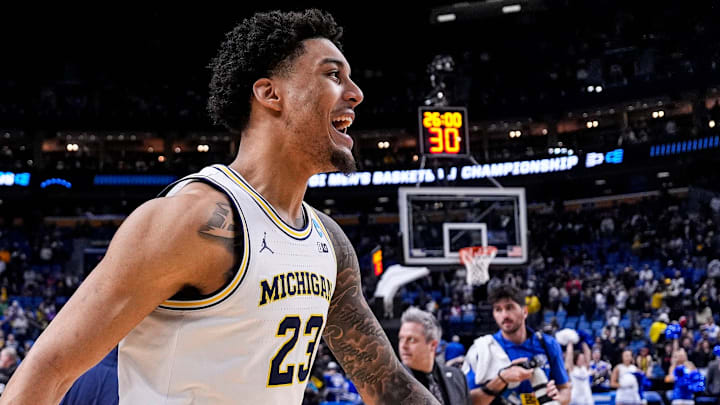
Ninth-seeded Saint Louis threw quite a punch in the first half of its Round of 32 matchup with Michigan on Saturday in Buffalo, New York, but the Wolverines didn’t stagger. 10 minutes into the first half, the Bilikens held a 27-23 lead, and traded baskets until the 6:55 mark, but from that point on, Michigan unleashed an avalanche of offense to run away with a 95-72 victory.
On the court after the game, CBS’s Allie LaForce asked the Big Ten Player of the Year how the Wolverines were able to pull away from a team coached by Dusty May’s close friend, Josh Schertz. Lendeborg’s simple response explains everything you need to know about why Michigan is a real threat to win its first national title since 1989.
“I would say our physicality on defense. We had more size than them, so we just tried to overload them with our size and just go out and run the fast break. We feel like we’re the more athletic team, and we played to our advantages,” Lendeborg told LaForce.
Michigan’s rim dominance is every great team’s superpower this year
Really, that’s the entire ethos of Dusty May basketball: “We had more size than them.” Last year, that manifested in the 4-5 pick-and-rolls between Danny Wolf and Vladislav Goldin, but May didn’t have enough around his dominant front-court duo. This year, He turned that size dial up another notch, building a supersized three-big lineup with Aday Mara, Morez Johnson Jr., and Lendeborg at the three.
Last year, Walter Clayton Jr. was the biggest story for the national champion Florida Gators, but Todd Golden’s recipe was not unlike May’s this year. Golden built a team to pressure the rim on both ends. Getting dunks and layups, gobbling up rebounds, and keeping opponents out of the paint. That interior dominance provides a massive floor, and if it's paired with enough shooting, it’s almost unbeatable.
A decade ago, Steph Curry’s Golden State Warriors ushered in a three-point revolution, and that trickled down to college basketball. While three is certainly more than two, high-volume three-point shooting introduces a tremendous amount of variance, and great teams that earn extra possessions with rebounding and get easy points on the inside can offset that.
It’s no surprise that all four No. 1 seeds in the NCAA Tournament stand out so much by paint point, different, and rebound differential.

It’s also no surprise that Schertz, an FAU alum who has long shared ideas with May, has built a mid-major version of May’s Michigan team. The Billikens stand out in the same metrics, but with mid-major athletes, they didn’t stand a chance against the real thing.
 Add us as a preferred source on Google