

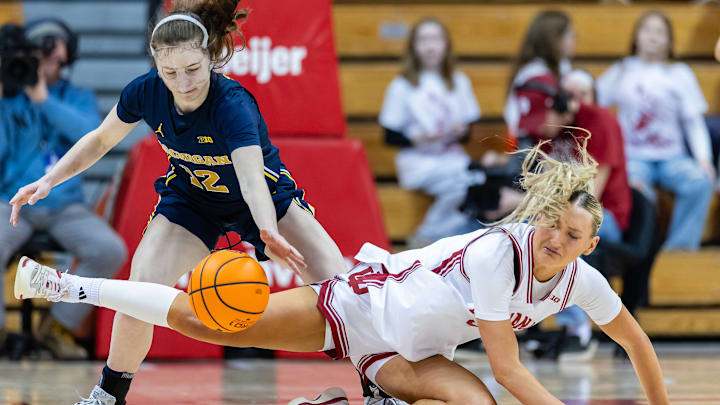
When facing the Michigan women’s basketball team, you have to handle their press. Opponents should know this and it’s assumed that they prepare for it. However, if Indiana did prepare, they did so poorly because they were buried 95-67 on their home court.
Michigan’s modus operandi is shot volume. Put up good shots as quickly as possible. To do this, the players must know what a good shot is, be confident enough to take it, and know what they must do next, because their responsibilities don’t end when the ball leaves their hand. To have a high shot volume, the opponent must cooperate as well by turning the ball over or shooting quickly so you can get the ball back. This is where Michigan’s “Jump Press” comes in.
What is it and why Michigan is good at it
The Jump Press is where the defense pressures the ball handler with a second defender, causing a mistake. The ball handler is closely guarded so she can’t easily cross the half-court line, then a second defender joins to trap her. Other defenders then rotate to the ball handler’s teammates, waiting for the inevitable looping pass or ill-aimed bounce pass that is likely to be intercepted.
In sophomore Mila Holloway and senior Brooke Quarles Daniels, Michigan has two excellent on-the-ball defenders who are quick and strong. The second defender watches the ball handler to see whether she is bringing the ball over the half court line. If she hesitates, that’s when the second defender “jumps in.” The rest of the defenders determine the targets for a pass and guard them. If a pass does find the unguarded player, the defenders quickly recover and find the new threats.
Since it is Michigan’s trademark, the team is well-drilled, and knowing what to do has become instinct. On top of that, the coaches’ scouting has identified the ball handlers, their tendencies, and their weaknesses. The problem for opponents is that very few teams use the Jump Press, so they don’t face it, nor do they extensively prepare for it. Even if they do, they cannot simulate the athleticism of Holloway, Quarles Daniels, et al. When they face it in a game, like Indiana did, all the scouting and preparation go out the window.
Don’t tell anyone, OK?
The easiest way to beat the press is to have Allen Iverson or a facsimile bring up the ball. Since AI has yet to replicate AI (at least not for a few years), how did the best B1G ball handlers fare? Penn St.’s Kiyomi McMiller had eight turnovers back on Jan 8th, and Jazzy Davidson had four on Jan 25th. Nebraska’s sophomore Britt Price (Feb 4th) and OSU sophomore Jaloni Cambridge (Feb 25th) will have their turn soon.
Here are things to remember. 1) Keep cool. 10 seconds is a relatively long time, and the count does not begin until the ball is touched. Catch the ball and scan the floor before you dribble. 2) NEVER PICK UP YOUR DRIBBLE. 3) Spread the floor and involve all five players. It’s OK to pass backwards. 4) Pass sharply. The bounce pass is your best option. 5) If everything fails, take the 10-second turnover call. It is better to set up your defense than the alternative of losing the ball and defending a two-on-one fast break.
But here’s the rub, if you do break the press. You’re all revved up and will shoot the first chance you get. Even if you make it, your team is all over the place, and Michigan is head up court.
 Add us as a preferred source on Google