

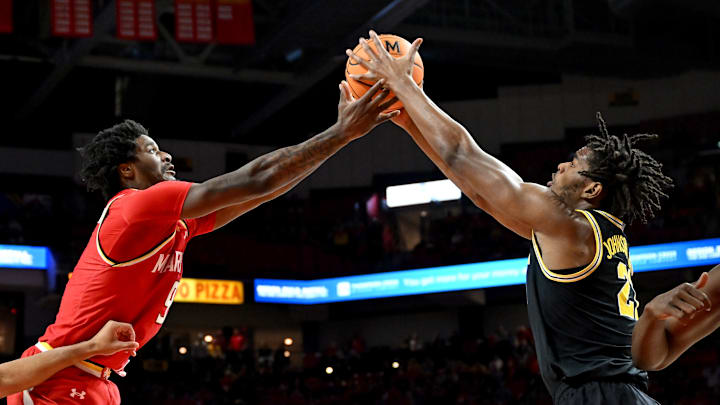
Twenty percent of defensive rebounding is a combination of physics and athletic ability. Eighty percent is positioning and boxing out: find your guy, make contact to stop their forward progress, seal them off by getting your body on them. Michigan basketball players know this, as do the coaches. So why did Maryland have 18 second-chance points?
The answer is that Michigan’s defensive style and commitment to challenge 3-point shots and stop anything at the rim, prevents them from applying the 80% defensive rebounding rule. This 80% is negatively affected when defenders run at shooters beyond the arc (potential rebounder removed from the equation), station defenders a step and a half away from potential 3-point shooters with the shooter within peripheral vision (makes finding your guy and making contact while the ball is in the air difficult), and stop a drive by or jump for a block (takes you out of position for the carom). Below are three examples of how defensive principles caused the second chance point.
Physics and Payne
It’s 13:25 in the 1st Half and David “Diggy” Coit is at the top of the key in a pick and roll. Coit has already been identified as a danger man, so Nimari Burnett, who is defending him, and Aday Mara, who has Pharrell Payne, are on alert. It is Payne who will eventually make the second chance points. Payne picks Burnett and Mara correctly challenges Coit, while Payne rolls to the rim. LJ Cason also correctly leaves Darius Adams in the corner to help. Coit passes to Adams for an open 3 that rims out.
Here's what’s happening underneath the rim: Turkson and Yax erase each other by going to the floor, Mara has his back turned to the rim but has identified Payne. Solomon Washington, Roddy Gayle, Jr.’s guy, is at the 3-point line, so he comes down and bumps Payne but doesn’t control him. Burnett sees Washington sneaking in and leaves Payne. The shot rims out to Payne who muscles Mara under the basket and slams it in his face.
Who’s fault is it? If you want to be fair, physics and Payne’s athletic ability made it happen. Gayle could’ve controlled Payne, but Washington was his responsibility. It was Mara’s guy who rebounded and scored, but if you rewind it, Mara was out of position because Coit had his attention (rightly so).
Mara did his job
It’s the next Maryland possession, and Payne dunks another miss. But this one is on Cason and Gayle because they fail to stop the Adams penetration. Mara followed defensive principles by deterring the rim attempt and successfully did so. But this left Payne all alone. Whose fault? Not Mara. Gayle should’ve stopped the paint attack but didn’t. Burnett and Yax were committed to stopping the 3, one of whom was Coit. Cason probably should’ve bodied Payne at the shot attempt but didn’t.
Gotta activate your glutes
One more 1st Half possession, which starts at 7:56 and ends up with a second chance make by Andrew Mills on a contested step-back 3. This one is instructive in terms of not boxing out your man. Coit missed a contested 3-point shot, one of his four misses, although you’d be forgiven if you forgot this because he did make eight! Trey McKenney had identified Mills and had an arm on him, but the shot rims out and Mills is first to the ball. McKenney did not control him by putting his behind on him.
Second chance points stat not a point of concern
Michigan basketball plays a high-event game, that is, they speed up the game so there will be a high volume of potential scoring opportunities and statistical occurrences leading to a hefty number of possessions. Their defensive principles also speed up the game, causing their opponents to play reactively on offense. Second-chance points occur because, in the course of the constant switching and challenging of shots, it’s hard to box out. The only solution is to try harder. If the past 10 games are any indication, the Wolverines will do so.
 Add us as a preferred source on Google